Students with Specific Learning Disorders (SLD) or Special Educational Needs (SEN) often encounter difficulties following traditional study methods.
This happens not due to lack of ability, but simply because those tools are not designed for the way they process information.
Reading long pages of text or taking notes during a lesson can become impossible when it's necessary to manage multiple activities simultaneously.
In the following paragraphs, we'll see together how AI can become a true ally for those with SLD or SEN, and what characteristics it must have to be truly useful.
The real difficulties of students with SLD and SEN in studying
To understand how AI can help, it's important to recognize the concrete challenges that many students with SLD and SEN face daily.
-
Reading difficulties
For those with dyslexia, reading a textbook or long handouts can require double or triple the time compared to other students. Words get confused, lines get lost, concentration drops rapidly.
It's not a matter of effort. It's a neurological characteristic. But the result is that studying becomes exhausting.
-
Writing difficulties
Taking notes during a lesson is a multiple challenge: you must listen, understand, synthesize, and write. All together, in real time.
For those with dysgraphia or other motor difficulties, manual writing is slow and tiring. And when concentration shifts too much to the form of letters, the thread of the discourse is lost.
-
Working memory difficulties
Keeping multiple pieces of information in mind simultaneously, doing mental calculations, remembering complex instructions: all of this can be more difficult when working memory is limited.
This makes it tiring to follow articulated explanations or study topics with many interconnections.
How to choose an adequate AI tool
When evaluating an AI tool for students with SLD or SEN, it's important to ask some questions:
-
Is it possible to upload your own materials?
If the AI only works on generic information, it's not suitable. It must be possible to upload your own PDFs, notes, and recordings.
-
Does the AI cite sources?
Every piece of information provided by the AI should be linked to the exact point of the document it comes from. This way it's possible to verify its reliability and go deeper if necessary.
-
Can you choose how to visualize information?
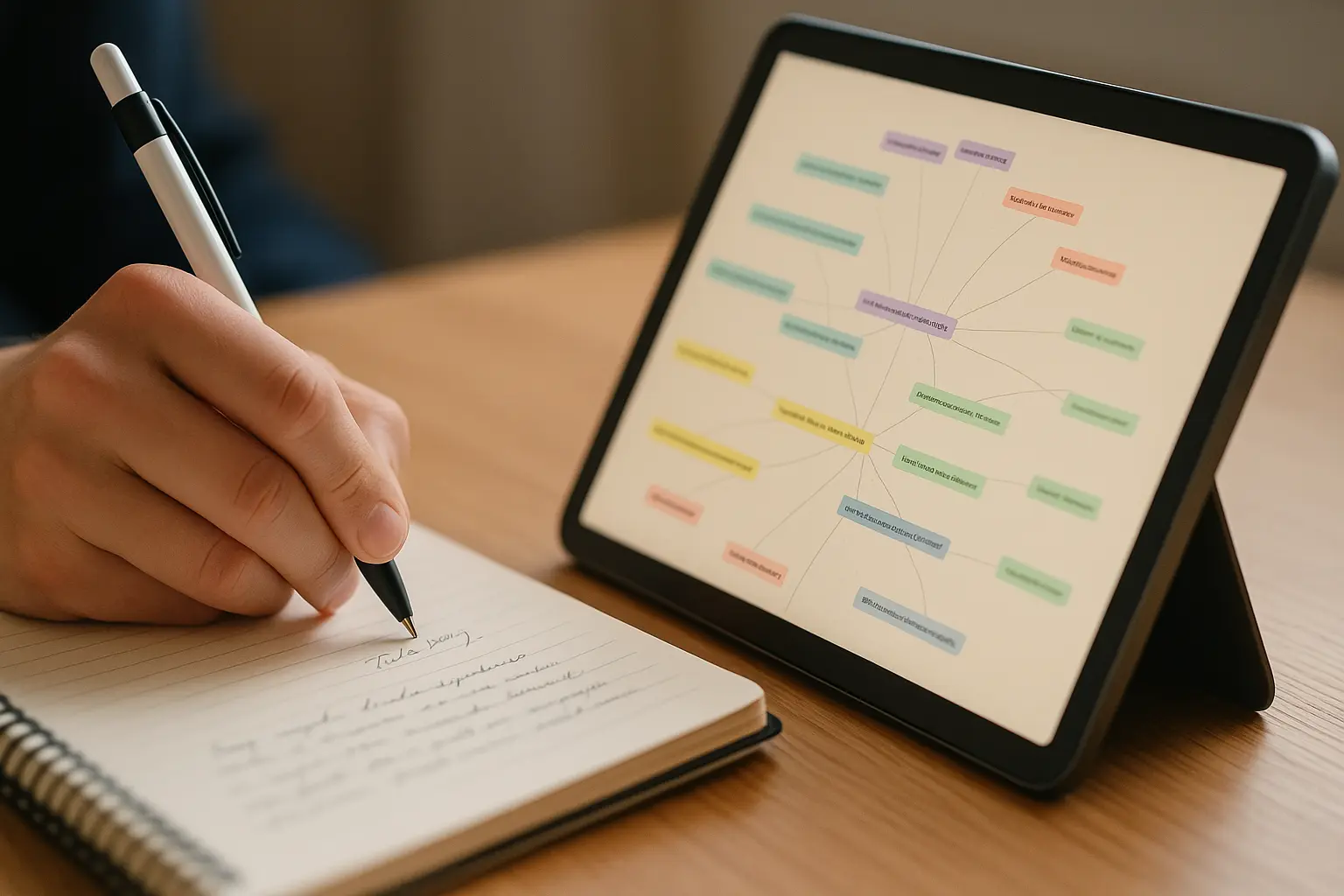
Mind maps, outlines, summaries: the tool must allow choosing the format most suited to your needs, to optimize learning.
-
Is the interface clear and accessible?
It's important to verify that the interface is intuitive. If it's confusing, with too many elements or hard-to-read text, it's probably not the right tool.
Not all AI is suitable: what's really needed
Not all AI tools are designed for students with SLD or SEN. Some can even make the situation worse.
-
Visual clarity
If the interface is chaotic, full of buttons, with small text and confusing colors, the AI doesn't help. In fact, it adds complexity.
A tool designed for accessibility must have a clean, clear interface with readable text.
-
Reliability
If the AI invents information or provides imprecise answers, it can create more problems than it can solve. Those with learning difficulties need certainty, not additional doubts.
For this reason, it's fundamental that the AI works on the student's specific sources (books, handouts, recordings) and always cites where it gets the information. This way it's possible to verify, trust, and study with peace of mind.
-
Flexibility
Every student learns differently. Some prefer mind maps, others textual summaries, others visual outlines.
A truly useful tool allows choosing the most suitable format, it doesn't impose a single way of seeing information.
-
Ease of use
If it takes hours to understand how the tool works, there's a problem. The AI must be immediate: you upload the material, you get the structure, you start studying.
No complex configurations, no difficult technical steps, just simplicity.
AI as a compensatory tool, not as a definitive solution
It's important to clarify one aspect: artificial intelligence doesn't "solve" SLD or SEN and doesn't change how the brain works. But it does something equally important: reduces barriers.
If a student has reading difficulties, AI can transform text into something more accessible. If they have organizational difficulties, AI can structure information. If they have writing difficulties, AI can transcribe while they speak.
It's a compensatory tool, like glasses for those with vision problems. They don't modify the eye, but they allow you to see better.
AI does the same: it allows studying better, reducing the impact of specific difficulties.
Conclusion: accessibility is for everyone, and AI can help
Well-designed AI tools can radically change the study experience for those with SLD or SEN.
They don't eliminate difficulties, but they attenuate them. And above all, they don't replace the student's commitment, but make it more effective.
The key is choosing tools truly designed for accessibility: when this happens, AI can become one of the best allies in studying. Not because it does the work instead of the student, but because it puts them in the conditions to do it at their best.
